Clerk of Works
UK Regulatory Compliance
Experienced Fire Specialists
Audit-Ready Reports
Trusted By Clients Nationwide
Passive Fire Building Surveys For Safer, Better Maintained Properties
Independent Fire Inspections Ltd provides passive fire building surveys to help responsible persons, building owners, managing agents and facilities teams understand the condition of key fire safety measures across their property.
Over time, buildings change. Maintenance works, refurbishment, new services, tenant alterations and general wear and tear can all affect the passive fire protection originally installed within a building. If these issues are not identified and managed, fire doors, compartmentation, fire stopping and other passive fire safety measures may no longer perform as intended.
There are four types of Fire Risk Assessment: Type 1, Type 2, Type 3 and Type 4. Independent Fire Inspections Ltd can assist you with each of these options, with Type 4 Fire Risk Assessments being the most comprehensive.
They include destructive sampling, but in both the common parts of a building and living areas – such as apartments and flats. Type 4 FRAs are comprehensive, and can be complicated to complete. This is because access to individual dwellings is required, and destructive sampling can necessitate repairs.
In addition to Fire Risk Assessments being completed at regular intervals, we recommend that any remedial works and upgrades are inspected as and when they happen, to ensure that all re-instatements are correct, and in line with the manufacturers specification, thus maintaining the integrity of the building.
It is also recommended that all fire doorsets are inspected every six months, to ensure that they continue to function correctly. Fire doors and surrounds are often subject to damage which would affect the way they perform in the event of a fire, it is therefore crucial to ensure that they continue to perform to their designed standards, in line with the buildings fire strategy.
Regular Fire Inspection & Maintenance Routines
A regular inspection and maintenance routine should be in place for all buildings, to ensure that passive fire protection remains effective, in the form of Fire Risk Assessments:
A fire risk assessment is a review undertaken of a building in order to assess its fire risk and offer recommendations to make the building safer. A building’s ‘responsible person’ must ensure they appoint a competent person to complete a fire risk assessment.
The Fire Risk Assessment must be reviewed regularly. It is recommended that the following be included in the review:
- Every 12 months after the original assessment is done
- Every 5 years a new assessment should be conducted
- If the building’s purpose has substantially changed.
- If the building structure has changed
Why Choose Independent Fire Inspections Ltd For A Fire Safety Building Survey?
Passive fire building surveys tailored to property type, use and risk profile
Survey support for individual buildings, estates and wider property portfolios
Inspection support for occupied, live and complex buildings
Visual review of fire doors, fire stopping, compartmentation and escape routes
Clear, evidence-led reporting with recommendations and next steps
Helping responsible persons identify defects and plan remedial works
What A Building Survey Can Review
Depending on the building and agreed scope, our passive fire building surveys can include a visual review of key fire safety measures such as fire doors, compartmentation lines, service penetrations, fire stopping, cavity barriers, fire-rated partitions, ceiling systems, fire-rated glazing, ductwork interfaces and protected escape routes.
The purpose is not always to inspect every individual product in the same depth as a dedicated service inspection. Instead, a building survey can provide a broader overview of visible passive fire protection condition and identify where more detailed investigation may be required.
Where specific issues are found, we can recommend targeted inspections or further review of individual systems, such as fire door inspections, penetration sealing and fire stopping inspections, cavity barrier inspections or compartmentation surveys.
When Should A Building Survey Be Considered?
A passive fire building survey may be useful where a building has changed, where fire safety records are incomplete, or where the responsible person wants a clearer understanding of passive fire protection condition.
Surveys can be particularly valuable after refurbishment works, maintenance activity, changes of layout, changes of use, contractor works, fire risk assessment findings or where there are concerns about the condition of fire doors, fire stopping, compartmentation or other passive fire safety measures.
They can also support ongoing fire safety management by helping clients prioritise further inspections, plan remedial works and maintain clearer records across a building or property portfolio.
Our Core Services
Our work is centred around the inspection and assessment of passive fire safety measures, including:
Fire Door Inspections
Detailed inspection of communal doors, flat entrance doors, riser doors and fire-resisting doorsets, with clear reporting on defects, condition and remedial priorities.

Penetration Sealing & Fire Stopping
Inspection of service penetrations, fire stopping systems, linear joints and seals to help assess whether compartmentation has been properly maintained.
Cavity Barrier Inspections
Inspection support for cavity barriers in external walls, roof voids, concealed spaces and compartment lines, helping identify damaged or incomplete barriers.
Fire-Rated Partitions & Ceiling Systems Inspection
Review of fire-rated partitions, ceiling systems, wall-head details, board construction, joints and interfaces to assess visible compartmentation integrity.
Fire-Rated Ducting & Fire Dampers Inspection
Inspection of fire-rated ductwork, fire dampers, access hatches, supports and duct penetrations to help identify defects affecting fire and smoke protection.

Structural Steel Fire Protection Inspection
Inspection and review of protected steelwork, including intumescent coatings, board encasement, spray-applied systems, interfaces and supporting evidence.

UKAS Accredited Passive Fire Protection Inspection
Independent UKAS accredited inspection support for defined passive fire protection systems, with evidence-led reporting, defect records and close-out guidance.
RIBA Stage 5 Passive Fire Protection Inspection
Construction-stage inspection support during RIBA Stage 5, helping teams inspect and record passive fire protection before key details become concealed.
Passive Fire Protection Technical Assessments
Technical review support for passive fire protection defects, non-standard details, evidence gaps and remediation routes where further clarity is required.
Why Passive Fire Building Surveys Matter
A building’s fire strategy relies on passive fire protection remaining effective throughout the life of the property. This includes fire-resisting walls and floors, fire doors, cavity barriers, fire stopping, service penetrations, protected routes and other measures that help limit the spread of fire and smoke.
However, these systems are often affected by everyday building use. Contractors may install new cables or pipework through compartment lines, doorsets may become damaged, ceilings may be altered, and original fire safety information may become outdated or incomplete.
A passive fire building survey helps identify these issues before they become more serious, giving responsible persons and building managers a clearer picture of the building’s current fire safety condition.
Clear Findings To Support Fire Safety Management
Following the survey, Independent Fire Inspections Ltd can provide a clear, structured report setting out the areas reviewed, the visible defects identified and any recommended next steps.
This gives clients a practical record of the building’s current passive fire protection condition, rather than a generic summary with limited action points.
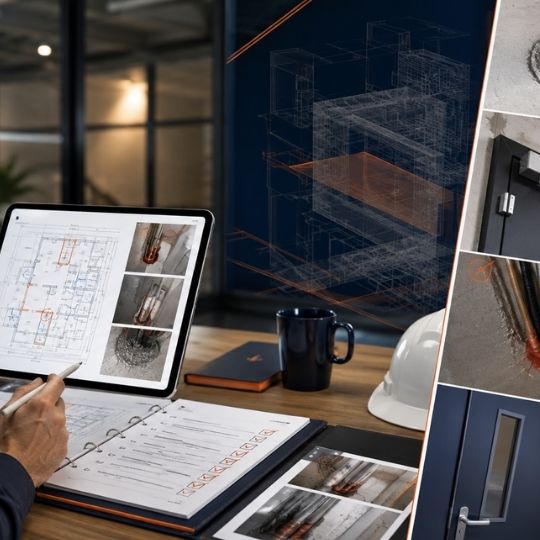
Our reports can include photographic evidence, location-based findings, observations on fire doors, fire stopping, compartmentation, service penetrations and other passive fire protection measures, along with practical recommendations to help clients understand what action may be required.
This gives responsible persons, building owners, managing agents and facilities teams usable information to support maintenance planning, contractor instruction, remedial works, fire risk assessment actions, compliance records and ongoing fire safety management across the building.
Supporting Fire Risk Assessment Reviews
Fire risk assessments should be reviewed regularly and updated where significant changes have occurred. A passive fire building survey can support this process by helping identify visible issues that may affect the building’s passive fire protection arrangements.
This can be particularly useful where a fire risk assessment has raised concerns, where remedial works have been completed, or where the building has undergone changes that may have affected compartmentation, fire doors, service penetrations or protected routes.
Need A Passive Fire Building Survey?
Speak to Independent Fire Inspections Ltd for clear, practical support with passive fire building surveys.
We can help you understand the current condition of your building’s passive fire protection measures, identify visible defects and provide practical recommendations to support safer building management.