
FIRE SAFETY COMPLIANCE
Cavity Barrier Inspection
Independent Fire Inspections Ltd provides professional cavity barrier inspection services for residential, commercial, healthcare, education, public-sector and higher-risk buildings across the UK.
- Independent Cavity Barrier Inspections Across The UK
- Inspection Of External Wall Cavities, Roof Voids, Ceiling Voids & Compartment Lines
- Checks For Missing, Damaged, Displaced or Incorrectly Installed Cavity Barriers
- Photographic Evidence, Defect Schedules & Clear Remedial Recommendations
- Support For Occupied Buildings, Construction Projects, Remediation Works & Handover
UK Regulatory Compliance
Experienced Fire Specialists
Audit-Ready Reports
Trusted By Clients Nationwide
Cavity Barrier Inspection Services From Independent Fire Inspections Ltd
Cavity barriers are a critical part of a building’s passive fire protection strategy. They are designed to restrict the unseen spread of fire and smoke through concealed spaces such as external wall cavities, roof voids, ceiling voids, floor voids, around openings and at compartment lines.
They are intended to restrict the movement of fire and smoke through concealed voids within a building’s construction. Where cavities are not properly closed, subdivided or protected, fire and smoke can travel unseen through the building fabric, bypassing compartment walls, floors, openings and other fire-resisting elements.
A cavity barrier inspection provides an independent review of accessible cavity barrier locations, installation quality, condition and visible defects.
This can be especially important during construction, refurbishment, fire safety remediation, façade works, compartmentation reviews and pre-handover inspections.
Independent Fire Inspections Ltd provides evidence-led cavity barrier inspection reports that help clients understand what has been inspected, what defects have been identified and what action may be required to support safer building management and passive fire protection compliance.
What Is A Cavity Barrier?
A cavity barrier is a passive fire protection measure used to close or subdivide concealed spaces within a building. These concealed spaces can occur in external walls, internal walls, floors, ceilings, roof voids, service zones and other areas where fire and smoke could otherwise spread unnoticed.
Cavity barriers are commonly required around openings, at the edges of cavities, at compartment lines, within external wall systems, at floor levels, around roof spaces and where cavities meet fire-resisting construction. Their purpose is to reduce the risk of fire and smoke travelling through hidden voids and undermining the building’s intended fire strategy.
Cavity barriers should be correctly specified, located, fixed, protected and recorded. If they are missing, damaged, cut, compressed, incorrectly installed or poorly supported, their effectiveness may be compromised.
Cavity Barrier Inspection Reports
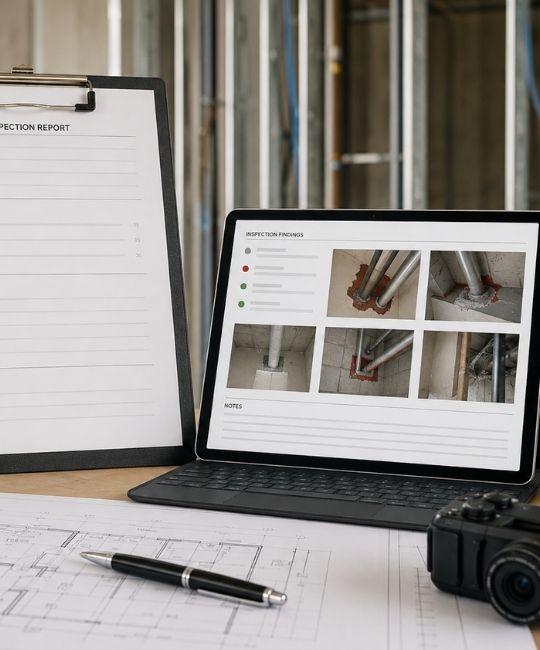
Following the inspection, Independent Fire Inspections Ltd can provide a clear, structured cavity barrier inspection report. The report can include:
- Areas inspected and access limitations
- Location-based findings
- Photographic evidence
- Defect descriptions
- Comments on visible condition and installation quality
- Identification of missing, damaged or incomplete barriers
- Notes on potential evidence gaps
- Practical remedial recommendations
- Prioritisation support where appropriate
- Information to support handover, remedial works or fire safety records
Our reports are designed to be practical and usable. They help clients understand the condition of accessible cavity barriers, communicate defects clearly to contractors and support a more organised approach to remedial planning and close-out.
Know The Risks. Plan The Solutions.
Why Cavity Barrier Inspections Matter
Cavity barriers are often hidden once construction is complete. This means defects can be difficult to identify later unless inspections are carried out at the right stage or where suitable access is available.
A cavity barrier inspection can help identify issues such as missing barriers, incorrect positioning, poor fixing, gaps, unsupported materials, damage from follow-on trades, incomplete installation around openings, or barriers that do not appear consistent with the intended design or manufacturer requirements.
For building owners, responsible persons and project teams, cavity barrier inspections provide useful evidence for remedial planning, quality assurance, handover records, building safety files and ongoing fire safety management.
What Our Cavity Barrier Inspections Cover
Our cavity barrier inspections cover key hidden voids, junctions and compartment lines where cavity barriers are intended to restrict the concealed spread of fire and smoke through the building fabric.
External Wall Cavities
We inspect cavity barrier locations within wall systems, including vertical and horizontal barrier lines, floor levels, compartment lines, interfaces and areas where cavities may allow concealed fire spread.
Roof Voids & Loft Spaces
We review accessible roof voids, loft spaces and concealed roof areas where cavity barriers may be required to restrict fire and smoke movement across compartments, separating walls or escape routes.
Ceiling Voids & Floor Voids
We inspect accessible ceiling and floor voids where cavity barriers may be needed to maintain compartmentation and prevent fire spread through voids above ceilings or below floors.
Riser & Shaft Interfaces
We assess accessible risers, shafts and service voids where cavity barriers and compartmentation details are critical to limiting vertical fire and smoke spread throughout a residential or commercial building.
Compartment Wall & Floor Junctions
We review cavity barrier locations where external walls, internal walls, floors, ceilings and roof spaces meet compartment walls, compartment floors or other fire-resisting construction.
Service Zones & Interface Details
We inspect accessible areas where building services, risers, ductwork, pipework, cable routes or other interfaces may affect the containment continuity or performance of cavity barriers which are in place.
Around Windows, Doors & Openings
We assess accessible cavity barrier provision around windows, doors, façade openings, service openings and other penetrations where concealed voids need to be properly closed or protected.
Remediation & Construction-Stage Works
We support construction and remedial projects by inspecting cavity barriers before they are concealed, helping project teams identify defects early and capture evidence for completion records.
Common Cavity Barrier Defects We Identify
Cavity barrier defects can occur during original construction, refurbishment, façade works, maintenance, building services installation or remedial works. Common issues include missing cavity barriers, damaged, torn or displaced barriers, incorrectly positioned barriers and barriers that are poorly fixed, unsupported or not installed in line with manufacturer guidance.
Defects may also be found around edges, openings and junctions, where gaps can reduce the effectiveness of the cavity barrier. In some cases, barriers may have been cut, disturbed or compromised by follow-on trades, particularly where new services, fixings or alterations have been introduced after the original installation.
Incomplete installation around windows, doors and façade openings can also create weaknesses, especially where the cavity barrier does not appear to properly close the concealed space. Unprotected service penetrations passing through cavity barrier lines, poor interface detailing between cavity barriers and fire stopping, incorrect product selection or a lack of supporting evidence can also affect the reliability of the installed protection.
In some buildings, limited access may prevent confirmation of hidden cavity barrier locations. Where issues are identified, our reports provide clear findings, photographs and practical recommendations to help clients understand the defect and plan the next step.
Our Cavity Barrier Inspection Process
Our cavity barrier inspection process provides a clear, evidence-led review of accessible cavity barriers, helping clients identify defects, understand installation issues and plan remedial works with confidence.
Inspection Scope Review
We review the building type, project stage, known concerns, available drawings, fire strategy information and any existing passive fire protection evidence to define a suitable inspection scope.
On-Site Cavity Barrier Inspection
Our inspectors assess accessible cavity barrier locations, checking visible condition, continuity, positioning, fixing, interface details and common defect areas.
Photographic Evidence Capture
We record key findings with photographic evidence, helping clients understand the location, nature and extent of identified cavity barrier defects.
Defect Identification & Reporting
We prepare a clear report setting out the areas inspected, defects identified, limitations encountered and recommended next steps.
Remedial Support & Close-Out
Where required, we can support remedial planning, reinspection and close-out reporting to help confirm that identified issues have been addressed.
When Should You Arrange A Cavity Barrier Inspection?
A cavity barrier inspection may be appropriate during construction, particularly when cavity barriers are about to be concealed by cladding, ceilings, finishes, boxing or other building elements. Early inspection can help identify defects before access becomes difficult, disruptive or costly.
Inspection may also be required where façade works, external wall remediation, refurbishment or passive fire protection remedial works are taking place. It can be especially useful where fire risk assessment actions have raised concerns about compartmentation, hidden fire spread, external wall cavities, roof voids, ceiling voids or other concealed spaces.
A cavity barrier inspection can also support projects approaching handover, occupation or close-out, helping contractors, responsible persons, building owners and managing agents gather clearer evidence of passive fire protection condition. It may also be appropriate where defects have already been identified in fire stopping, compartmentation or façade interfaces and further investigation is needed.
For occupied buildings, a cavity barrier inspection can help building owners, managing agents and facilities teams better understand the condition of accessible cavity barriers and support ongoing fire safety records, remedial planning and maintenance decisions.
Why Choose Independent Fire Inspections Ltd?
Independent Fire Inspections Ltd provides specialist cavity barrier inspection services with a practical, evidence-led approach.
We understand that cavity barrier inspections need to be clear, structured and useful. Cavity barriers are often hidden within external wall cavities, roof voids, ceiling voids, floor voids and compartment lines, so defects can be difficult to identify once construction is complete.
Our role is to help clients identify missing, damaged, displaced, or incorrectly installed cavity barriers, understand potential fire spread risks, and make informed decisions about remedial works, maintenance, and ongoing fire safety management.
Clients choose us for specialist passive fire inspection experience, clear reports with photographic evidence, practical remedial recommendations, and inspection support for occupied, live, and complex buildings.
Our reporting is designed for responsible persons, building owners, managing agents, facilities managers, contractors and project teams who need straightforward information they can use.
Specialist cavity barrier inspection experience & knowledge
Clear reports with photographic evidence and location-based findings
Detailed checks of external wall cavities, roof voids and concealed spaces
Support for compartment lines, openings, junctions and interfaces
Inspection services for occupied, live and complex buildings
Practical recommendations for remedial works and compliance records
Need A Cavity Barrier Inspection?
We inspect accessible cavity barriers in external walls, roof voids, ceiling voids, compartment lines, risers, openings and key passive fire protection interfaces, providing evidence-led reports and practical remedial recommendations.
Cavity Barrier Inspection FAQs
What is a cavity barrier inspection?
A cavity barrier inspection is a visual inspection of accessible cavity barriers within a building.
The inspection checks whether cavity barriers appear to be present, correctly located, suitably installed, undamaged and capable of helping restrict concealed fire and smoke spread through voids and cavities.
Why are cavity barriers important?
Cavity barriers help restrict the unseen spread of fire and smoke through concealed spaces within walls, floors, ceilings, roof voids and external wall systems.
Without suitable cavity barriers, fire can bypass compartment lines and spread through hidden voids.
Where are cavity barriers usually inspected?
Cavity barriers may be inspected in external wall cavities, roof voids, loft spaces, ceiling voids, floor voids, risers, service zones, around windows and doors, at compartment wall junctions and at other locations where concealed cavities need to be closed or subdivided.
What defects can a cavity barrier inspection find?
Common defects include missing cavity barriers, damaged barriers, incorrect positioning, poor fixing, gaps around edges, incomplete installation around openings, barriers disturbed by follow-on trades and areas where there is insufficient evidence to confirm the installed detail.
Do cavity barriers need to be inspected during construction?
Construction-stage inspection is often valuable because cavity barriers can become concealed by cladding, plasterboard, ceilings, finishes or other building elements. Inspecting before concealment helps identify defects early and provides useful photographic evidence for handover records.
Can cavity barriers be inspected in occupied buildings?
Yes. Cavity barriers can often be inspected in occupied buildings where safe and suitable access is available.
However, some areas may be hidden behind finishes, ceilings, cladding or fixed construction, so the report should clearly identify any access limitations.
Is a cavity barrier inspection the same as a fire stopping inspection?
No. Cavity barriers and fire stopping are related parts of passive fire protection, but they are not the same.
Cavity barriers are used to close or subdivide concealed cavities, while fire stopping is generally used to seal joints, gaps and service penetrations through fire-resisting construction.
Who needs a cavity barrier inspection?
Cavity barrier inspections may be needed by building owners, landlords, managing agents, responsible persons, contractors, developers, housing providers, healthcare estates teams, facilities managers and project teams involved in construction, refurbishment, fire safety remediation or handover.
What will I receive after a cavity barrier inspection?
You can receive a structured report setting out the areas inspected, findings, photographs, defects, access limitations and recommended remedial actions. This can support maintenance planning, remedial works, handover records and ongoing fire safety management.
Can you reinspect cavity barrier remedial works?
Yes. Independent Fire Inspections Ltd can support remedial close-out by reinspecting accessible areas after works have been completed and providing updated reporting to help confirm progress against the original findings.
Browse Our Resources
Our Services
Practical passive fire inspection services covering fire doors, compartmentation, fire stopping and key life safety measures.
Accreditations
Trusted fire safety expertise supported by recognised training, professional standards and inspection-led knowledge.
Learn About Us
Experienced fire inspection specialists helping clients identify defects, reduce risk and maintain safer buildings.
Read Our Blogs
Useful fire safety guidance, inspection advice and updates on passive fire protection, compliance and building safety.
Get Expert Analysis On Your Cavity Barriers!








Send Us A Message
Need A Professional Fire Door Inspection?
Speak to Independent Fire Inspections for clear, practical fire door inspection support. We provide detailed inspection reports, photographic evidence and remedial recommendations to help you understand the condition of your fire doors and manage your fire safety responsibilities.