
FIRE SAFETY COMPLIANCE
Structural Steel Fire Protection Inspection
IFI Group inspects and reviews structural steel fire protection where fire resistance is provided by intumescent coatings, board encasement, spray-applied products, hybrid details or local interface solutions. Our support can help with:
- Inspection of intumescent coatings, board encasement and spray-applied fire protection
- Review of DFT records, coating condition, adhesion and system continuity
- Assessment of protected beams, columns, connections and interface details
- Identification of coating omissions, damaged protection and unverified junctions
- Clear reporting to support remediation, handover and passive fire protection close-out
UK Regulatory Compliance
Experienced Fire Specialists
Audit-Ready Reports
Trusted By Clients Nationwide
Technical Review Of Protected Steelwork
The purpose of a structural steel fire protection inspection is to verify whether the installed protection can be evidenced against the required fire resistance period, specification and actual site condition.
This includes reviewing not only the visible condition of the system, but also the supporting evidence behind it, such as product data, application records, dry film thickness information, board details, fixing information and relevant project documentation.
IFI Group supports clients, contractors, designers and dutyholders by reviewing whether structural steel fire protection appears consistent with the intended design and available technical information. Our approach is practical and evidence-led, helping project teams understand what has been installed, what documentation supports it, where the risks are and what needs to be clarified before works are accepted or closed out.
Typical Issues Identified
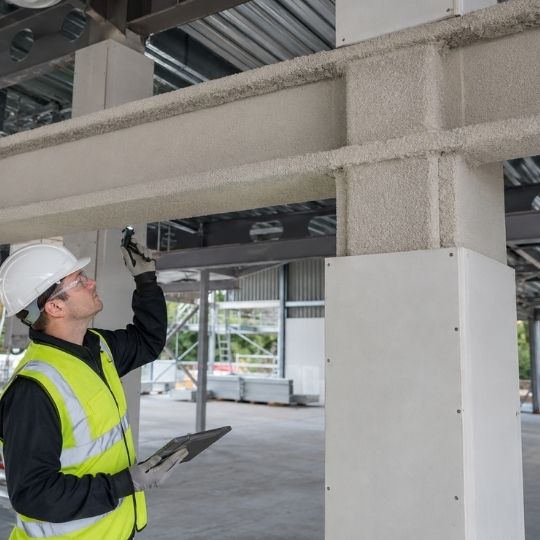
Structural steel fire protection defects are often found at junctions, connection zones, concealed areas and interfaces with other passive fire protection systems.
Common issues include insufficient dry film thickness, coating omissions, poor curing, delamination, damaged coatings, poor adhesion, unprotected connection zones, missing coat-back, undocumented board boxing, mixed systems, concealed junctions and unverified interfaces with compartment walls.
We also commonly see issues where later works have affected the original protection, such as service penetrations, fixings, brackets, supports, ceiling interfaces or local alterations that have not been properly reviewed or reinstated.
Identifying these issues early helps project teams understand whether the steel protection is adequately evidenced, whether remedial works are required and whether further manufacturer, specialist contractor or fire engineering input may be needed.
What The Inspection Should Include
A structural steel fire protection inspection should consider more than the visible coating or board system alone. The required fire period, steel member identity, protection type and supporting evidence all need to be understood.
Depending on the scope, the inspection may consider the steel member reference, section factor data, coating specification, primer, basecoat and topcoat compatibility, DFT records, adhesion evidence, board thickness, fixing method, joint details, connection protection, access constraints and any areas where the installed condition differs from the expected detail.
Where intumescent coatings are used, DFT readings can form an important part of the evidence, but they should not be reviewed in isolation. Coating continuity, surface condition, curing, adhesion, environmental exposure and compatibility with the substrate and coating system also need to be considered.
Where board encasement or wet spray systems are used, the inspection may need to consider system type, thickness, fixings, joints, support arrangements, damage, gaps and the treatment of connections or local interfaces.
Interfaces Matter
Structural steel fire protection often fails at the interfaces rather than across the obvious open spans.
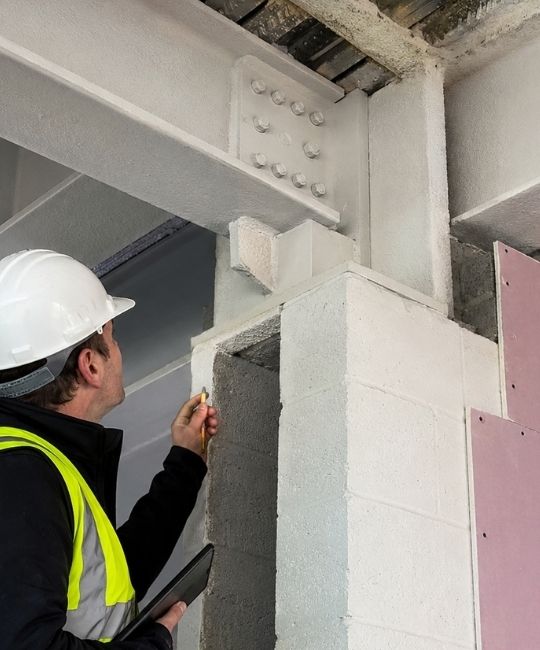
Wall heads, risers, service penetrations, cellular beam openings, column junctions, brackets, bolts, end plates, compartment wall interfaces and mixed product transitions can all affect whether the intended fire protection is continuous and properly evidenced.
These details should be included within the inspection scope and should not be treated as secondary items. A beam may appear well protected along its length, but if the connections, bearing points or interface details are incomplete, unsupported or undocumented, the overall fire protection strategy may still be compromised.
IFI Group can help identify these interface risks and advise where further inspection, opening-up, manufacturer confirmation or remedial evidence may be required.
Best Fit Projects
Structural steel fire protection inspection support is well suited to commercial fit-outs, high-rise residential buildings, healthcare projects, education buildings, government offices, remediation schemes, CAT-A and CAT-B interfaces, construction close-out and projects where steel protection evidence needs technical review.
It is also valuable where multiple passive fire protection systems meet, where different contractors have worked on the same interface, or where original installation records are incomplete.
Structural Steel Fire Protection Inspections Deliverables
IFI Group can provide structured reporting to help clients understand what has been inspected, what evidence has been reviewed and what issues remain unresolved.
Typical deliverables can include inspection reports, photographic evidence schedules, DFT review comments, missing evidence schedules, pin-based observations, remedial option tables, action trackers and inspection or test plan recommendations.
Where appropriate, we can also provide comments on whether further product evidence, manufacturer confirmation, opening-up, specialist testing or formal assessment may be required before a detail is accepted.
Our reporting is designed to support practical close-out. The aim is to give clients, contractors, designers and dutyholders a clear record of what is supported, what is not verified and what actions are required next.
Supporting Remediation Before Works Start
Structural steel fire protection issues are often more difficult and costly to resolve once surrounding finishes, ceilings, walls or services are complete.
IFI Group can support projects before remedial works start by reviewing the available drawings, pin records, photographs, specification information, coating records, DFT data and proposed remedial details.
Early review can help identify buildability issues, access constraints, evidence requirements, interface risks and inspection hold points before works are priced, installed or closed out. This helps reduce uncertainty and supports a more controlled remediation process.
Request An Inspection Scope
IFI Group can review the available information, identify evidence gaps and help advise on the most appropriate next step for inspection, remediation, manufacturer input or close-out.
Structural Steel Fire Protection Inspection FAQs
Can DFT alone prove compliance?
No. Dry film thickness readings are only one part of the evidence for intumescent coating systems.
DFT records should be considered alongside coating condition, curing, adhesion, continuity, surface preparation, primer compatibility, topcoat suitability, environmental exposure and whether the coating system is appropriate for the steel section and required fire resistance period.
Do you inspect cellular or castellated beams?
Yes. Cellular and castellated beams can be inspected, but they often require careful evidence review because generic details may not cover the actual site condition.
Openings, web posts, service routes, coating thickness, board details and interface conditions should be reviewed against suitable technical evidence and project requirements.
Can IFI support before remedial works start?
Yes. Early review is often highly valuable because it helps identify buildability issues, access constraints, evidence gaps and inspection requirements before remedial works are priced or installed.
This can help reduce the risk of unsupported details being accepted at close-out.
What are common defects in structural steel fire protection?
Common defects include missing or damaged protection, insufficient DFT, poor coating adhesion, delamination, unprotected connection zones, incomplete board encasement, poor fixing details, damaged wet spray, missing coat-back and unverified interfaces with walls, services or compartment lines.
What information is useful for a structural steel fire protection review?
Useful information can include steelwork drawings, fire strategy information, coating specifications, DFT records, product data, board system details, photographs, pin records, test evidence, manufacturer guidance, inspection records and proposed remedial details.
Can structural steel fire protection be reviewed during remediation?
Yes. Structural steel fire protection review is often useful during remediation because it helps project teams understand what evidence supports the proposed works, where inspection hold points may be required and what information should be captured before areas are closed up.
Browse Our Resources
Our Services
Practical passive fire inspection services covering fire doors, compartmentation, fire stopping and key life safety measures.
Accreditations
Trusted fire safety expertise supported by recognised training, professional standards and inspection-led knowledge.
Learn About Us
Experienced fire inspection specialists helping clients identify defects, reduce risk and maintain safer buildings.
Read Our Blogs
Useful fire safety guidance, inspection advice and updates on passive fire protection, compliance and building safety.
Request an inspection scope





Send Us A Message
Need A Professional Fire Door Inspection?
Speak to Independent Fire Inspections for clear, practical fire door inspection support. We provide detailed inspection reports, photographic evidence and remedial recommendations to help you understand the condition of your fire doors and manage your fire safety responsibilities.