
FIRE SAFETY COMPLIANCE
Passive Fire Protection Technical Assessments
IFI Group supports project teams where passive fire protection issues require technical review, evidence assessment and a clear, defensible close-out route. Our technical assessment support can help with:
- Reviewing passive fire protection defects, interfaces and evidence gaps
- Assessing proposed remedial details against available test evidence and manufacturer guidance
- Identifying unsupported, non-standard or poorly evidenced installation details
- Supporting remediation planning, handover reviews and Regulation 38 close-out
- Providing clear recommendations for further evidence, opening-up, manufacturer input or formal assessment
UK Regulatory Compliance
Experienced Fire Specialists
Audit-Ready Reports
Trusted By Clients Nationwide
Technical Review & Evidence Assessment
Our passive fire protection technical assessments help clients understand whether installed or proposed fire protection details are supported by suitable test evidence, manufacturer guidance, project drawings, site records and competent design input. This can be particularly valuable where defects have been identified, installation evidence is incomplete, or site conditions differ from standard tested details.
We work with clients, principal contractors, designers, responsible persons and remediation teams to review the available information, identify evidence gaps and provide practical recommendations for next steps.
When A Technical Assessment Is Needed
A passive fire protection inspection and technical assessment is often required where the installed detail does not clearly match the original specification, tested system or manufacturer guidance.
This may include situations where site conditions differ from standard tested details, where different passive fire protection systems meet, where services interrupt compartmentation, or where existing installations are concealed, damaged, incomplete or poorly evidenced.
Technical assessment support can also be useful during remediation planning, quality audits, handover reviews, Regulation 38 close-out, defect resolution and construction-stage decision-making. By reviewing the available evidence early, project teams can better understand what can be accepted, what needs further verification and what may require remedial action.
What The Assessment Considers
Our technical assessments are tailored to the specific passive fire protection issue being reviewed.
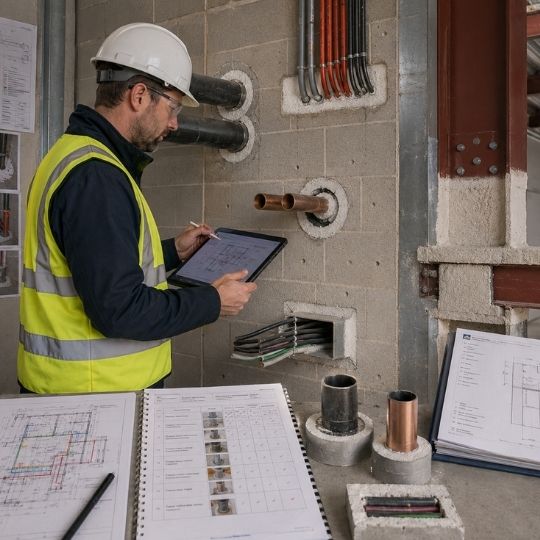
Depending on the project, this may include consideration of the fire strategy requirement, compartment line, product evidence, tested detail, substrate, service type, aperture size, annular gap, support conditions, installation records and inspection accessibility.
We can also review interfaces between passive fire protection systems, including service penetrations, linear gaps, cavity barriers, shaft wall details, fire-resisting partitions, structural steel protection and other areas where fire stopping or compartmentation may be affected.
Where relevant, we consider whether the proposed or installed detail appears to fall within the direct field of application of the supporting evidence, or whether additional confirmation, opening-up, specialist review, formal assessment or competent fire engineering input may be required.
Typical Outputs
Typical outputs from a passive fire protection technical assessment can include technical review notes, evidence gap schedules, remedial option appraisals, risk commentary, action trackers and recommendations for further investigation.
Where appropriate, we can also provide comments on drawings, pin records, photographic evidence, installation details, product data, manufacturer guidance, test reports, assessments and close-out records.
Our aim is to provide a clear and practical record of what has been reviewed, what evidence is available, what remains unresolved and what next steps are required to support a defensible close-out route.
Best Fit Projects
Passive fire protection technical assessments are well suited to commercial fit-outs, high-rise residential projects, healthcare schemes, education buildings, government offices, remediation works, CAT-A and CAT-B fit-out interfaces, and projects where an independent technical review is required.
They are also useful where different contractors, systems or phases of work meet, particularly around compartmentation lines, service penetrations, risers, ceiling voids, structural steel interfaces and fire stopping details that may be difficult to verify after completion.
Supporting Remediation, Handover & Close-Out
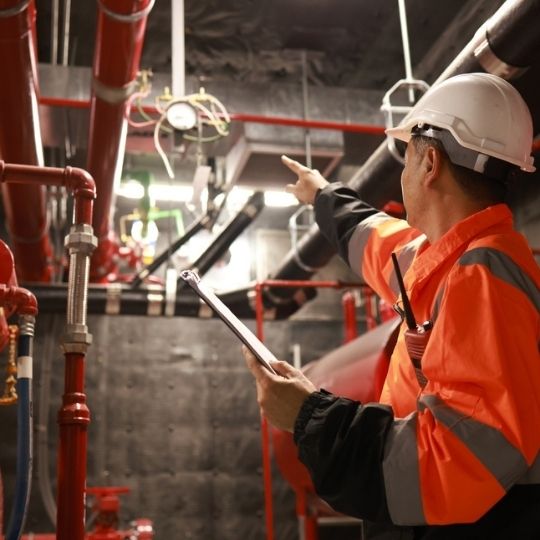
Passive fire protection issues are often discovered during construction, refurbishment, fire risk assessment actions or intrusive inspection works. In many cases, the key challenge is not only identifying the defect, but understanding how it can be resolved and what evidence is needed to support acceptance.
IFI Group can support project teams by reviewing proposed remedial details, comparing installation records against available evidence, and helping identify whether further manufacturer confirmation, product data, opening-up or formal assessment is required.
This can help reduce uncertainty during remediation works, improve the quality of close-out information and support clearer communication between clients, contractors, designers and dutyholders.
Important Limitation
A technical assessment is not a substitute for product test evidence, manufacturer approval, formal assessment or fire engineering judgement where a detail falls outside the direct field of application.
Our role is to review the information available and help identify what appears supported, what remains non-verified and what further evidence may be required. Where a detail cannot be justified from the available information, the assessment should clearly state the limitation and recommend the appropriate next step.
This approach helps clients avoid accepting unsupported details and provides a clearer audit trail for passive fire protection decision-making.
Request A Technical Assessment
To arrange support, send us your drawings, photographs, pin records, product data, test evidence, defect schedules or proposed remedial details.
Passive Fire Protection Inspection Technical Assessments FAQs
Can IFI approve untested details?
Untested or non-standard details should not be accepted without suitable supporting evidence, assessment or competent fire engineering justification.
IFI can help review the available information and identify whether the detail appears supported, whether further evidence is required, or whether specialist assessment should be sought.
What documents are needed for a technical assessment?
Useful documents can include drawings, fire strategy information, product data, test reports, assessment reports, manufacturer guidance, photographs, installation records, marked-up plans, pin records and any existing defect schedules.
The more complete the evidence pack, the easier it is to understand whether the proposed or installed detail can be supported.
Can this support a remediation feasibility study?
Yes. Passive fire protection technical assessments can be useful at the feasibility stage because they help identify which remedial routes are practical, buildable and potentially supportable before works proceed.
This can help project teams understand likely evidence requirements, coordination issues, access limitations and areas where further inspection or manufacturer input may be required.
When is a passive fire protection technical assessment useful?
A technical assessment is useful when there is uncertainty around a passive fire protection detail, defect, interface or proposed remedial solution.
This may include service penetrations, cavity barriers, linear joints, compartmentation interfaces, fire-rated partitions, structural steel protection or areas where installation evidence is incomplete.
Is a technical assessment the same as a fire stopping inspection?
No. A fire stopping inspection reviews the installed condition of fire stopping and penetration sealing systems.
A technical assessment focuses more on reviewing the supporting evidence, design intent, proposed remedial details and whether a particular passive fire protection issue has a defensible close-out route.
Can you review photographs and pin records remotely?
Yes, in some cases. Drawings, photographs, pin records and installation evidence can often be reviewed before a site visit or as part of an initial technical assessment.
However, where the evidence is unclear, incomplete, or contradictory, further inspection or opening up may be required.
Browse Our Resources
Our Services
Practical passive fire inspection services covering fire doors, compartmentation, fire stopping and key life safety measures.
Accreditations
Trusted fire safety expertise supported by recognised training, professional standards and inspection-led knowledge.
Learn About Us
Experienced fire inspection specialists helping clients identify defects, reduce risk and maintain safer buildings.
Read Our Blogs
Useful fire safety guidance, inspection advice and updates on passive fire protection, compliance and building safety.
Request an inspection scope








Send Us A Message
Need A Professional Fire Door Inspection?
Speak to Independent Fire Inspections for clear, practical fire door inspection support. We provide detailed inspection reports, photographic evidence and remedial recommendations to help you understand the condition of your fire doors and manage your fire safety responsibilities.